
Introduction
Learning apps for kids are no longer just about screen time—they are about whether that time is actually supporting real learning. Parents and teachers are dealing with a real screening problem now: not whether kids use screens, but whether any of that screen time is doing meaningful educational work.
The 2025 Common Sense Census found that children ages eight and under still spend about 2.5 hours a day with digital media, while gaming time has increased and the overall media landscape has become harder to evaluate quickly. At the same time, guidance from the American Academy of Pediatrics emphasizes the quality and context of media use rather than a single universal time limit.
That is why, when evaluating learning apps for kids, it is more useful to focus on practical criteria rather than popularity or branding. Start with a few key questions: Does the app support a clear learning goal? Is it developmentally appropriate? Can a child use it independently? Is the experience calm, clear, and worth the price? And will it still fit into a classroom or family routine after the novelty wears off?
Guidance from early childhood experts points in the same direction—effective learning apps for kids should match the child, the setting, and the learning context, rather than assuming one highly rated app works for everyone.
Best Learning Apps Quick Comparison Table
| App | Best For | Age | Focus | Price |
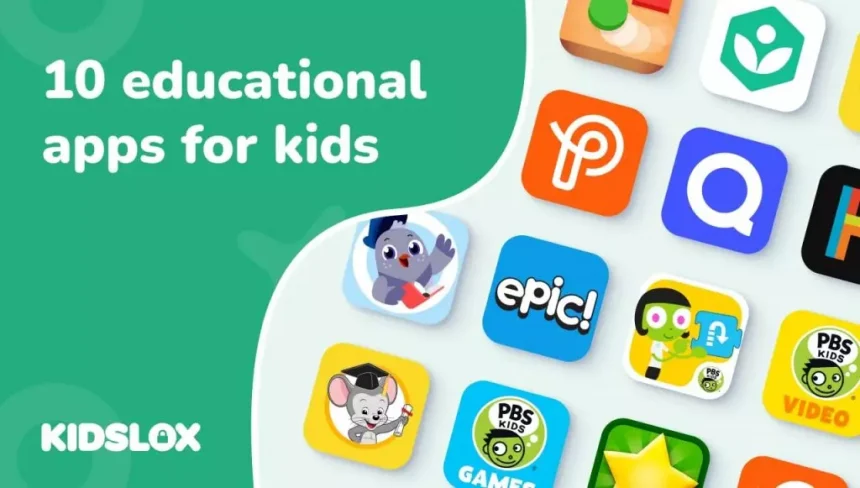
| Epic | Reading volume and choice | 4–12 | Digital books, Read-To-Me, audiobooks, quizzes | $13.99/month or $84.99/year |
| ABCmouse | Structured early learning | 2–8 | Reading, math, science, art, music, social studies | Free basic; Premium $14.99/month or $45/year on web |
| Khan Academy Kids | Best free early-learning app | 2–8 | Reading, math, writing, SEL, creative play | Free |
| Duolingo | Language practice for older kids | 6+ with supervision | Languages, plus math/music/chess in the main app | Free core; optional paid upgrades |
| Prodigy | Gamified math practice | 6–12 | Math first; science and English with selected memberships | Free core; memberships from $58.95/year |
| PBS KIDS | Free playful preschool and early elementary learning | 2–8 | Math, reading, science, art, SEL games | Free |
| ScratchJr | Intro coding and creative thinking | 5-7 | Sequencing, coding logic, storytelling | Free |
Source note: the comparison above synthesizes current parent-facing plans, official age guidance, app-store listings, and recent expert reviews as of May 5, 2026. Prices can vary by platform and region, especially for Duolingo and ABCmouse.
APPS In Details
Epic
Overview. If my main goal is helping a child read more, read more often, and read across a wider range of interests, Epic is the strongest option in this list. Official Epic materials describe it as a kid-safe digital reading platform for children 12 and under with more than 40,000 books, audiobooks, videos, quizzes, and Read-To-Me titles, plus offline access and progress-oriented features.
Educational value. What makes Epic stand out is not that it teaches every subject. It does not. What it does exceptionally well is remove friction between curiosity and reading. A child can move from picture books to nonfiction, comics, audiobooks, or read-aloud support without leaving the same ecosystem, and the platform includes age- and level-based curation, highlighted Read-To-Me text, audiobooks, and reading stats. That makes it unusually strong for building reading stamina, choice, and volume rather than just isolated skill drills.
Ideal use cases. I would recommend Epic most confidently for home reading routines, travel, classroom-to-home reading continuity, and families trying to create a genuine “digital library” feel. It is also the easiest app in this roundup to support with strong internal editorial content. In a publish-ready version of this article, I would naturally link Epic to books for 3rd graders for independent readers, read-to-me books for emergent readers, audiobooks for kids for car rides and bedtime listening, and books for reluctant readers when motivation is the real bottleneck.
ABCmouse
Overview. ABCmouse is the most curriculum-like app in this roundup for younger children. Official pages describe it as an early-learning program for ages 2 to 8 with over 10,000 activities on its main learning pages and more than 13,000 activities in Premium, covering reading, math, science, social studies, art, and music through a structured learning path.
Educational value. That makes it valuable for parents and teachers who want scaffolded progression instead of open browsing. Its step-by-step pathway, grade customization, reward system, and spoken instructions can work especially well for preschool, pre-K, kindergarten, and early first-grade learners who benefit from routine and repetition.
Ideal use cases. I would use ABCmouse for structured after-school practice, summer skill maintenance, or home support for early readers and beginner math learners. It is a particularly sensible fit when the adult wants “do the next lesson” simplicity rather than a library model where the child chooses everything independently.
Khan Academy Kids
Overview. Khan Academy Kids is the best pure value pick in this guide because it is genuinely robust and genuinely free. Official pages describe it as an ad-free, subscription-free app for ages 2 to 8 with thousands of activities, books, and videos across early literacy, reading, writing, language, math, social-emotional learning, and creative play.
Educational value. This app stands out because it supports the whole child instead of only one academic lane. Khan Academy Kids explicitly combines foundational academics with social-emotional growth and creative work, and its curriculum was developed with learning experts at Stanford and aligned with Head Start and Common Core. For families or classrooms that want a calm, high-quality default app instead of a marketplace of upsells, that is a major advantage.
Ideal use cases. I would recommend Khan Academy Kids first for preschool and early elementary families who want a free app that still feels teacher-approved, and for classrooms that need reliable early-learning content without budget friction. It is also one of the few apps here that works well for both skill practice and slightly more exploratory learning.
Duolingo
Overview. For language learning, I would still put Duolingo on the shortlist, but with an important caveat: I think it is a better fit for older elementary students and up than for very young children. Official listings describe the main app as a free, bite-sized platform for learning 40+ languages through speaking, reading, listening, and writing practice.
Educational value. Duolingo’s biggest strength is consistency. Short lessons, rewards, streaks, and clear feedback can make language practice feel manageable enough to happen every day, which matters more than many parents admit. Apple’s Editors’ Choice write-up specifically praises the app’s genuinely fun structure and says its mini-games support reading, writing, and speaking practice. Official Duolingo copy also frames the methodology as science-based and designed by language experts.
Ideal use cases. I would use Duolingo for older kids who are curious about Spanish, French, Japanese, or another language and need a practice tool more than a full formal course. It is especially useful for short daily sessions, family language goals, and school enrichment. I would not make it my only language-learning resource if the goal is deep speaking confidence or grammar explanation.
Prodigy
Overview. Prodigy is still one of the clearest examples of how much gamification can help with math motivation. Official pages say its math and English content are free, while science content and additional game features sit behind memberships; math content runs through grades 1–8, science through grades 1–6, and English through grades 1–6.
Educational value. The app’s real strength is engagement. Prodigy’s teacher-facing materials emphasize standards alignment, reports, assessments, classroom management tools, and a game structure that turns practice into an adventure. In plain English, that means it works best when a teacher or parent is using the game to channel practice toward a real skill goal instead of treating the game loop itself as the curriculum.
Ideal use cases. I would recommend Prodigy for grade-school children who resist traditional math practice, for centers and homework reinforcement, and for teachers who want a free classroom tool with strong student buy-in. It is most useful when adults are actually checking the dashboard, adjusting levels, and tying it to current classroom skills.
PBS KIDS
Overview. PBS KIDS is the easiest recommendation in this list if your top priorities are “free,” “safe,” and “good for younger kids.” Official app listings describe PBS KIDS Games as a safe, curriculum-based collection of 280+ free games for ages 2–8, with content in English and Spanish and regular additions tied to familiar characters.
Educational value. PBS KIDS does not try to be a single linear curriculum, and that is both a strength and a limitation. It offers broad exposure to reading, math, science, art, SEL, routines, and creative play through games built around trusted shows. That makes it especially effective for low-stakes educational play, station choices, short free-choice windows, and parent-approved downtime that still has learning upside.
Ideal use cases. I would choose PBS KIDS for preschoolers and younger elementary learners, especially when the adult wants zero cost and very little setup. It is also a strong pick for bilingual or Spanish-support use because official listings note 50+ Spanish-language educational games.
ScratchJr
Educational value. This is why ScratchJr belongs in a broader “learning apps” list. It teaches more than coding syntax. Official descriptions emphasize problem-solving, project design, sequencing, numeracy, and literacy in a meaningful context. In other words, children are not just consuming content; they are making something. That is a different kind of educational value than a reading or math drill app, and an important one.
Ideal use cases. I would recommend ScratchJr for kindergarten and first-grade maker time, coding centers, story-retelling projects, and any child who likes to create characters and animate ideas. It is especially useful for schools and families that want a first coding step without text-heavy menus or syntax.
How to Choose the Right Learning App
The fastest way to choose badly is to ask, “Which app is best?” A better question is, “Best for what?”
NAEYC’s guidance is useful here: start with the child, the setting, and the intended learning outcome.
For children who need more reading volume and book choice, a library-style platform like Epic! is often a stronger fit than a rigid lesson path.
Younger learners who benefit from guided instruction may do better with structured platforms such as ABCmouse or Khan Academy Kids.
When motivation is the main challenge—especially in math—game-based tools like Prodigy Math can be more effective than traditional worksheet-style apps.
The second filter is independence. AAP guidance now pushes parents to think beyond raw screen hours and consider content quality, co-use, balance, and whether the activity supports real development. In practice, that means younger children benefit most from calm, ad-free, clearly scaffolded tools, while older elementary students can handle more open-ended or gamified products. It also means pricing and ad load matter. Duolingo’s free version contains ads; Khan Academy Kids is fully free with no ads; ABCmouse and Epic are paid family products; PBS KIDS and ScratchJr are free; Prodigy’s free tier is real, but the memberships are a visible part of the product design.

Are Learning Apps Actually Effective?
Yes, they can be effective, but only under the right conditions. AAP guidance explicitly argues that families should judge digital media by quality and context, not by a simplistic hour count, while NAEYC likewise says there are no universal app rules that work without understanding the child, the app, and the learning setting.
The research base is supportive but not naive. A 2024 systematic review in SAGE Open found that digital technologies can support young children’s language and literacy development, but effectiveness varies considerably depending on the content, app features, age appropriateness, adult mediation, and the broader learning context. The same review emphasizes that teachers and caregivers remain central in guiding children toward appropriate digital resources and making the learning “stick” beyond the screen.
At the product level, some apps have stronger evidence than others. Khan Academy’s 2026 research post points to a randomized controlled trial showing gains in preschoolers’ emergent literacy skills. ABCmouse also cites randomized trial evidence for literacy and math gains, though that research is company-run and should be interpreted with that in mind. Those examples do not prove that every educational app works; they show that some do have a more serious evidence story than the average app-store claim.
My practical conclusion is simple: learning apps work best as tools, not substitutes. They are strongest when they reinforce a specific goal, when the app quality is high, and when adults use them to extend learning into real books, discussion, writing, play, and hands-on practice. That is why I would treat Epic as a reading ecosystem, Khan Academy Kids as a strong free early-learning support, and ScratchJr as a launchpad for creative coding rather than expecting any one app to replace teaching, conversation, or off-screen learning.
Learning Apps vs Traditional Learning: Which Is Better?
| Learning Apps | Traditional Learning |
| Traditional Learning | Structured & guided |
| Self-paced | Teacher-led |
| Accessible anytime | Limited to schedule |
The best results usually come from combining both:
- Apps for practice and engagement
- Books and offline activities for deeper understanding
👉 For example, pairing a reading app with physical books can significantly improve reading confidence.
Quick FAQ
What is the best free learning app for kids?
If I have to choose one free all-around app for ages 2–8, it is Khan Academy Kids because it combines reading, math, social-emotional learning, creative work, and an ad-free design. For lighter preschool play, PBS KIDS is also excellent, and for beginner coding, ScratchJr is hard to beat.
Is Epic worth paying for?
If your family’s priority is reading volume, book access, audiobooks, and read-aloud support in one kid-safe place, yes, Epic is a strong paid choice. If your main goal is structured math or a broader curriculum, another product will usually offer better value for the same budget.
Which app is best for reluctant learners?
That depends on what they resist. For reluctant readers, I would start with Epic and support it with strong editorial browsing pathways like books for reluctant readers, read-to-me books, and audiobooks for kids. For reluctant math learners, Prodigy is still one of the strongest motivation plays because of its fantasy-game structure.
Are learning apps enough on their own?
No. The strongest guidance from AAP and NAEYC points toward balance, adult support, and real-world extension. High-quality learning apps can help a lot, but they work best when paired with conversation, print books, practice, and experiences away from the screen.