
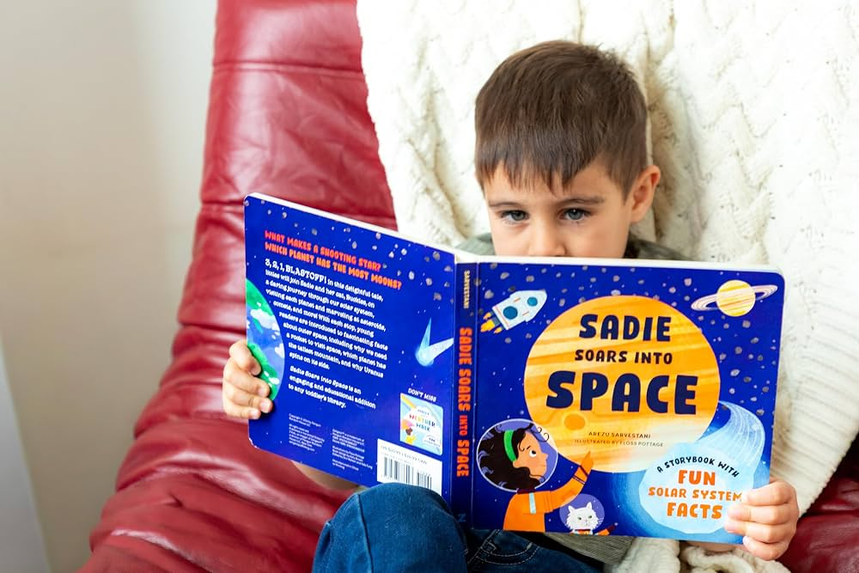
Space has a way of making kids curious. Planets, astronauts, rockets, stars, black holes, the Moon, and everything beyond Earth can lead to some pretty big questions, and space books for kids are a great way to explore those questions together.
Some children love learning real facts about the solar system, while others would rather follow an astronaut on an adventure or read a funny story set in space. That is why this list includes a mix of nonfiction, picture books, early readers, chapter books, and more.
If your child is currently obsessed with planets or keeps asking questions about astronauts, there is a good chance one of these books will give them something new to explore.
What Makes a Good Space Book for Kids?
The best space book for a child depends a lot on their age, reading ability, and interests.
A younger child might enjoy a colorful picture book that introduces the planets with simple facts. An early reader may be ready for a nonfiction book about astronauts or the Moon. Older elementary readers might prefer a chapter book with a mystery or adventure that happens in space.
You also do not have to stick with nonfiction. Fiction can be a great way to get children interested in a subject they might not otherwise choose to read about.
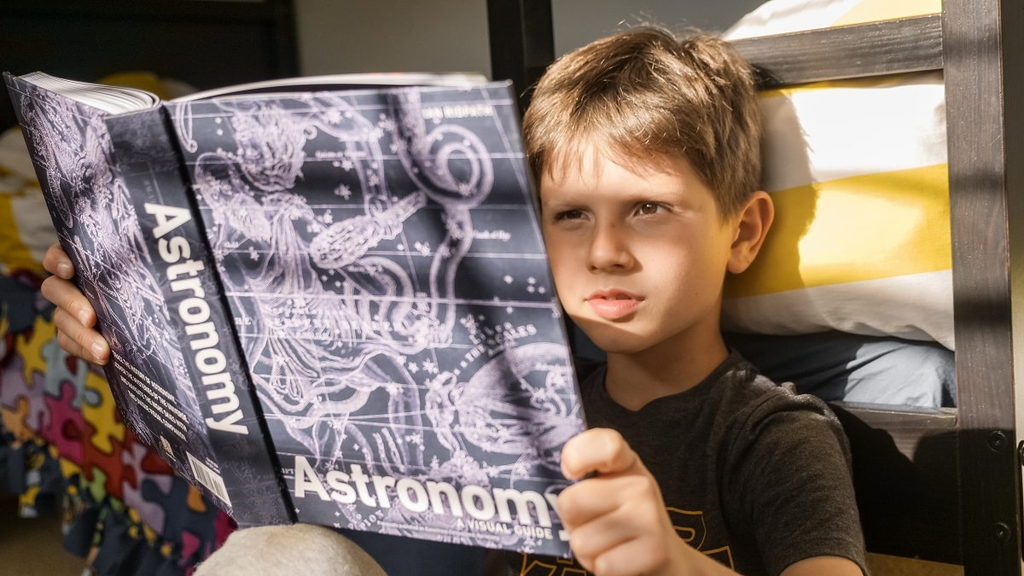
With that in mind, here are 20 space books worth checking out.
20 Best Space Books for Kids
1. National Geographic Little Kids First Big Book of Space by Catherine D. Hughes
This is a great starting point for younger children who are fascinated by space but are not ready for a dense encyclopedia.
The book introduces young readers to planets, stars, astronauts, and other space topics with colorful illustrations, photographs, and simple explanations. It works especially well for kids who like to flip through books and discover interesting facts rather than read one long story from beginning to end.
Good for: Ages 4–8 and young space fans who enjoy nonfiction.
2. Hello, World! Solar System by Jill McDonald
For very young readers, Hello, World! Solar System offers a simple introduction to the Sun, Moon, stars, and planets.
The bright illustrations and straightforward information make this a good choice for toddlers and preschoolers who are just beginning to learn about space. It can also work well as a read-aloud before children are ready to explore space books independently.
Good for: Toddlers and preschoolers.
3. There’s No Place Like Space! All About Our Solar System by Tish Rabe
Kids who already enjoy Dr. Seuss may have an easier time getting interested in space through this playful introduction to the solar system.
The book covers planets, the Sun, the Moon, constellations, and astronauts while using the familiar Cat in the Hat style of storytelling. The rhyming format can also make some of the new vocabulary easier for young children to remember.
Good for: Ages 5–9 and children who enjoy rhyming books.
4. Look Up! by Nathan Bryon
Look Up! follows Rocket, a young girl who is fascinated by space and especially excited about an upcoming meteor shower.
This is more of a character-driven picture book than a traditional space encyclopedia, which is part of what makes it interesting. It connects a child’s curiosity about space with family, community, and the excitement of looking up at the night sky.
Good for: Ages 4–8 and children who enjoy stories with enthusiastic main characters.
5. The Darkest Dark by Chris Hadfield
What happens when a child who dreams about space is also afraid of the dark?
Written by astronaut Chris Hadfield, The Darkest Dark follows a young boy who gradually discovers that space can be exciting rather than frightening. It is a particularly nice choice for children who are interested in astronauts but may also have some worries about darkness or the unknown.
Good for: Ages 4–8 and children who enjoy astronaut stories.
6. Professor Astro Cat’s Frontiers of Space by Dominic Walliman
Professor Astro Cat takes young readers on a tour through the universe in this illustrated science book.
The book introduces concepts such as planets, stars, galaxies, gravity, and space travel while keeping the presentation playful and visual. It is a good option for kids who want more information than a simple picture book provides but are not quite ready for a traditional encyclopedia.
Good for: Ages 5–8 and curious early readers.
7. The Magic School Bus: Lost in the Solar System by Joanna Cole
If your child already loves The Magic School Bus, this is an easy space recommendation.
Ms. Frizzle’s class takes a very unusual field trip through the solar system, giving children opportunities to learn about planets and space while following the familiar characters they already know.
The combination of humor, illustrations, and science makes this a particularly approachable choice for children who might not voluntarily pick up a straightforward science reference book.
Good for: Ages 5–8 and fans of The Magic School Bus.
8. National Geographic Readers: Planets
For children who are beginning to read independently, the National Geographic Readers series is worth checking out.
Planets introduces young readers to the planets of our solar system using photographs, short sections, and accessible text. The format gives children the chance to learn real information while practicing their reading skills.
Good for: Early readers who enjoy nonfiction.
9. Weird But True! Space by National Geographic Kids
Some kids will happily read a book from beginning to end. Others would rather open a random page and immediately discover something weird.
Weird But True! Space is designed for the second group.
The book is packed with unusual facts about planets, astronauts, rockets, galaxies, black holes, and other space topics. The short, browsable format makes it especially useful for kids who have trouble sticking with longer nonfiction books.
Good for: Ages 8–12 and kids who love random facts.
10. What Was the First Moon Landing? by Nathan Page
The Apollo 11 Moon landing is one of those historical events that can make a great starting point for learning about space exploration.
This book introduces young readers to the story of the first Moon landing and the people involved in making it happen. It can also lead naturally into conversations about astronauts, spacecraft, NASA, and how space exploration has changed over time.
Good for: Elementary readers interested in space history.
11. AstroNuts Mission One: The Plant Planet by Jon Scieszka
For kids who prefer their science with plenty of humor, the AstroNuts series offers a very different approach to space.
The story follows a group of animal characters on an unusual mission involving the environment, science, and a mysterious planet. It gives children a fictional adventure to follow while introducing real scientific ideas along the way.
Good for: Elementary readers who enjoy funny chapter books.
12. Moonshot: The Flight of Apollo 11 by Brian Floca
Moonshot tells the story of Apollo 11’s journey to the Moon through detailed illustrations and engaging text.
This is a good choice for children who are fascinated by the historical side of space exploration. It can also work well as a read-aloud because there is plenty to look at and discuss on each page.
Good for: Ages 6–10 and kids interested in the Apollo missions.
13. Ada Lace, Take Me to Your Leader by Emily Calandrelli
Ada Lace is a young inventor who loves science, technology, and solving problems.
In Take Me to Your Leader, Ada’s curiosity takes her into a space-themed adventure. The story can be a fun option for children who like STEM topics but want to experience them through a character and plot rather than a nonfiction book.
Good for: Early elementary readers and children who enjoy STEM-focused stories.
14. Space Case by Stuart Gibbs
Older elementary readers who are ready for a longer mystery may enjoy Space Case.
The story takes place on a Moon base where a group of kids becomes involved in solving a mystery. Instead of simply teaching children about space, the book uses the setting to create a full chapter-book adventure.
Good for: Upper elementary readers who enjoy mysteries and chapter books.
15. Space Rocks! by Tom O’Donnell
Space Rocks! combines a science-fiction adventure with plenty of action.
The story follows four kids who become caught up in an intergalactic conflict after being left in space. It is a good reminder that space books do not always need to be about memorizing planet facts. Sometimes a child just needs a fun story that happens to take place among the stars.
Good for: Ages 8–12 and readers who prefer science-fiction adventures.
16. The Mysteries of the Universe by Will Gater
Some children eventually move beyond learning the names of the planets and start asking much bigger questions.
The Mysteries of the Universe explores stars, galaxies, black holes, planets, and some of the unanswered questions scientists are still investigating. The visual presentation makes complicated ideas more approachable for curious older readers.
Good for: Older elementary readers who want more detailed nonfiction.
17. National Geographic Kids Everything Space
This is another option for children who want a lot of information in one place.
Everything Space covers a wide range of topics, including planets, astronauts, spacecraft, stars, and space exploration. The book’s visual format makes it easy for children to browse instead of feeling like they have to read every page in order.
Good for: Elementary readers who enjoy encyclopedias and fact books.
18. There’s No Place Like Space and Other Space-Themed Read-Alouds
Not every space book needs to become an independent reading assignment.
Space-themed picture books and read-alouds can be especially useful for younger children who are interested in astronomy but are still developing their reading skills. A parent can read the text while the child focuses on the illustrations, asks questions, and talks about what they see.
This is also a good way to expose children to vocabulary that may be above their independent reading level.
Good for: Younger children and families looking for shared reading options.
19. Women in Space: 23 Stories of First Flights, Scientific Missions, and Gravity-Breaking Adventures by Karen Bush Gibson
Space exploration has involved far more people than just the astronauts whose names are most familiar.
This book introduces readers to women who have contributed to space exploration and science, giving children a chance to learn about different careers and accomplishments connected to space.
It can be a particularly interesting choice for children who are beginning to wonder what people actually do in the world of science and space exploration.
Good for: Elementary readers interested in astronauts, science, and real-life stories.
20. The Solar System by Jill McDonald
For younger readers who want a straightforward introduction to the solar system, Jill McDonald’s The Solar System is another approachable option.
The book uses simple explanations and colorful illustrations to introduce children to the planets and other objects in our solar system. It can work particularly well as a first step before children move into more detailed space nonfiction.
Good for: Preschool and early elementary readers.
How to Choose the Right Space Book for Your Child
With so many space books for kids available, it can be tempting to simply choose the one with the most impressive-looking cover. However, the best choice usually depends on what your child actually enjoys reading.
If your child loves facts, try a nonfiction book with photographs, diagrams, and short sections. If they prefer stories, look for a picture book, mystery, or chapter book where space is part of the adventure.
Reading level matters too. A child may understand and enjoy a book that is above their independent reading level when an adult reads it aloud. That can be a great way to introduce new vocabulary and ideas without turning the experience into a frustrating reading exercise.
For more ideas about finding books that match a child’s interests and reading needs, you can also explore our other reading resources below.
Let Kids Explore Different Types of Space Books
You do not have to choose between fiction and nonfiction.
A child might read a funny story about astronauts one day and then spend the next day flipping through a book about planets. They might enjoy a picture book about the Moon even after they are technically old enough for a chapter book. The best space books for kids come in a variety of genres and styles.
That variety can actually be helpful. Different types of books give children different reasons to read, and following those interests can make it easier to keep reading regularly.
Digital reading libraries can also give children more opportunities to explore. Epic, for example, has space collections with books about planets, astronauts, spacecraft, space stations, the Moon, and other topics. That can be useful when a child wants to explore a subject but does not yet know exactly which book they want to read.
Use Space Books to Encourage More Reading
One of the best things about a strong interest in space is that it can lead somewhere else.
A child might start with a book about planets and become interested in astronauts. That interest could lead to a book about the Apollo missions, which could lead to questions about engineering, physics, history, or even writing their own fictional space adventure.
You do not need to turn every book into a lesson. Sometimes the best thing you can do is let your child become curious and follow that curiosity.
If your child is still developing their reading habits, you can also check out our guide on How to Build a Reading Routine for Kids That Actually Sticks for ideas on making reading a regular part of the day.
Reading Space Books With Younger Kids
Younger children may not be able to read an entire space book independently, but that does not mean they cannot enjoy one.
Read the book together and let your child stop you whenever they have a question. Point out interesting pictures, talk about the planets, and let them make guesses about what they are seeing.
For more ideas on making shared reading enjoyable, see our guide on How to Read Aloud to Kids.
Reading together also gives children an opportunity to hear more advanced vocabulary and sentence structures than they may encounter in their independent reading.

What If My Child Is Not Interested in Space Books?
That is completely fine.
A child does not need to love every subject in order to become a strong reader. If space does not interest them, try something else. Animals, sports, mysteries, funny stories, graphic novels, fantasy, and nonfiction about everyday topics can all provide opportunities to practice reading.
The goal is not to convince every child that space is fascinating. The goal is to find books that give your child a reason to keep turning the pages.
Final Thoughts
Space books for kids can be a great way to combine reading with a child’s natural curiosity.
Whether your child wants to learn about planets, follow astronauts, solve a mystery on the Moon, or simply discover strange facts about the universe, there are plenty of books to choose from.
Try offering a few different options rather than choosing one book for them. A colorful nonfiction book might catch their attention one day, while a funny space adventure might be exactly what they want the next.
And if a child finds a space book that makes them ask, “Wait… is that actually true?” you may have just found the beginning of their next reading rabbit hole.
FAQ: Space Books for Kids
What Are the Best Space Books for Young Kids?
For younger children, books such as Hello, World! Solar System, National Geographic Little Kids First Big Book of Space, and There’s No Place Like Space! can provide approachable introductions to planets, stars, astronauts, and the solar system.
What Are Good Space Books for Early Readers?
Early readers may enjoy nonfiction books such as National Geographic Readers: Planets or story-based books such as The Magic School Bus: Lost in the Solar System. Look for books with manageable text, strong visual support, and topics your child already finds interesting.
Are Space Books Good for Reluctant Readers?
They can be. High-interest nonfiction is sometimes a useful way to encourage a child who does not enjoy traditional stories. Short sections, photographs, unusual facts, and visual elements can give children more opportunities to find something that catches their attention.
If your child consistently dislikes reading, it can also help to understand what might be behind that reaction. Our guide Why Does My Child Hate Reading? Real Reasons and How to Help covers some common reasons children may resist reading.
Should Kids Read Fiction or Nonfiction Space Books?
There is no need to choose just one. Fiction can give children an exciting story to follow, while nonfiction can satisfy their curiosity about real planets, astronauts, spacecraft, and scientific discoveries. Letting children move between different types of books can keep reading interesting.
Can I Read Space Books Aloud to My Child?
Absolutely. Read-alouds are a great way to introduce children to books that are too difficult for them to read independently. You can pause to discuss pictures, explain unfamiliar words, and let your child ask questions about the information they are learning.
How Can I Encourage My Child to Read More Space Books?
Give them choices. You might put several space books in front of them and let them decide which one looks most interesting. You can also follow their questions. If they become fascinated by Mars, for example, look for another book about Mars rather than immediately switching to a completely different topic.
Related Reading Resources
- How to Read Aloud to Kids: A Parent’s Guide to Making Storytime Fun
- How to Build a Reading Routine for Kids That Actually Sticks
- Why Does My Child Hate Reading? Real Reasons and How to Help
- What Counts as Reading for Kids?